Bitcoin Halving Explained: How the 4-Year Supply Cut Works and What It Means for Investors

Affiliate disclosure: Some links on this site may be affiliate links. If you purchase through them, we may earn a commission at no extra cost to you. This does not change our editorial standards.

Updated: 16 October 2026
A Bitcoin halving cuts the reward miners receive for each new block by 50%, and it happens automatically every 210,000 blocks, roughly every four years. The most recent halving took place on 20 April 2024 at block 840,000, reducing the reward from 6.25 to 3.125 bitcoin. The next one is due at block 1,050,000, which on current block times points to around 2028.
Halvings are among the few fully predictable events in any financial market. This guide explains how the mechanism works, what it does and does not change, what history shows, and what Indian investors should weigh before acting on halving narratives.
Table of Contents
What Is a Bitcoin Halving?
Bitcoin has no central bank. New coins enter circulation only as a reward to miners, who use computing power to add blocks of transactions to the blockchain. That reward is called the block subsidy.
The Bitcoin protocol, set out by Satoshi Nakamoto in 2008 and launched in January 2009, fixes how that subsidy changes. It started at 50 bitcoin per block. Every 210,000 blocks, the code halves it. Because a block is found about every ten minutes on average, 210,000 blocks take close to four years.
This schedule is why total supply can never exceed 21 million bitcoin. Each halving makes new supply smaller, and the subsidy is expected to reach zero around the year 2140. After that, miners will rely only on transaction fees.
Bitcoin Halving History: 2012 to 2024
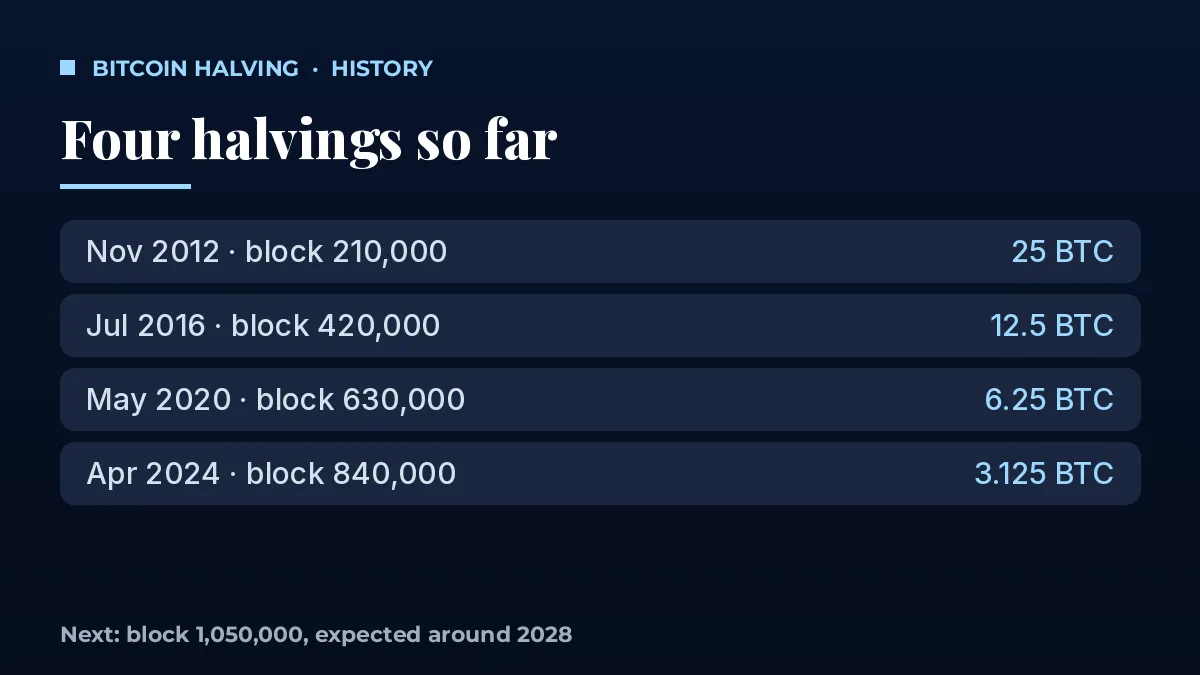
There have been four halvings so far. Each one cut the block subsidy in half:
| Halving | Date | Block height | Reward after |
|---|---|---|---|
| 1st | 28 November 2012 | 210,000 | 25 BTC |
| 2nd | 9 July 2016 | 420,000 | 12.5 BTC |
| 3rd | 11 May 2020 | 630,000 | 6.25 BTC |
| 4th | 20 April 2024 | 840,000 | 3.125 BTC |
| 5th (expected) | around 2028 | 1,050,000 | 1.5625 BTC |
The pattern is mechanical, so the reward after each Bitcoin halving is known decades in advance. Only the date shifts slightly, because block times vary with mining power.
Why the Bitcoin Halving Matters for Supply
A halving does not change how many bitcoin exist. It changes how fast new ones arrive. After April 2024, daily new issuance fell from about 900 to about 450 bitcoin, assuming roughly 144 blocks a day.
As a result, Bitcoin’s annual supply inflation rate is now below 1%, lower than the inflation targets of most central banks. By most block-explorer counts, roughly 95% of the 21 million cap has already been mined. Each future halving therefore matters less in absolute terms, because the remaining new supply is small.
This is the core of the “scarcity” argument. Supporters say a shrinking flow of new coins, against steady or rising demand, should support prices over time. Critics reply that the halving schedule is public knowledge, so markets should already price it in.
What History Shows About Prices
Each of the first three halvings was followed, within roughly 12 to 18 months, by a large bull market and then a deep drawdown. That pattern made the Bitcoin halving a popular market story.
However, three cautions apply. First, three or four cycles are far too few to prove cause and effect. Second, other forces moved prices at the same time, including global liquidity, interest rates and new access channels. The 2024 cycle, for example, coincided with the US Securities and Exchange Commission approving spot bitcoin exchange-traded products in January 2024, which opened a large new demand channel before the halving even happened. Third, past performance does not guarantee future results, and crypto assets can fall sharply.
In short, the halving is a supply event with a known timetable. Its effect on price is debated and cannot be predicted reliably.
What the Halving Means for Miners
For miners, the effect is immediate and concrete. Overnight, their subsidy income in bitcoin terms drops by half, while electricity and hardware costs stay the same.
Miners respond in a few ways. Less efficient operators switch off older machines. Others move to cheaper power, such as stranded natural gas or surplus hydro. Many listed miners also diversify into data centres and AI computing. Transaction fees become more important too, especially during periods of heavy network use.
That said, the network adjusts. Bitcoin’s difficulty adjustment, which recalibrates every 2,016 blocks, keeps block times close to ten minutes even if some miners leave. The halving can squeeze miner profits, but it does not stop the network.
How to Track the Next Halving Yourself
You do not need to rely on social media countdowns. Because the Bitcoin halving is tied to block height, anyone can check progress on a public block explorer. Look up the current block height and subtract it from 1,050,000. Then multiply the remaining blocks by about ten minutes to get a rough date.
For example, if 100,000 blocks remain, that is about 1,000,000 minutes, or close to 694 days. The estimate moves a little each week, because blocks arrive faster when more mining power joins and slower when miners switch off. Treat any single “halving date” as approximate until the final few weeks.
It also helps to watch two related numbers. The first is the network hash rate, which shows how much computing power secures the chain. The second is the share of miner revenue coming from transaction fees. If fees rise as a share of income, the network is becoming less dependent on the shrinking block reward over time.
Bitcoin Halving and Indian Investors: Tax and Rules
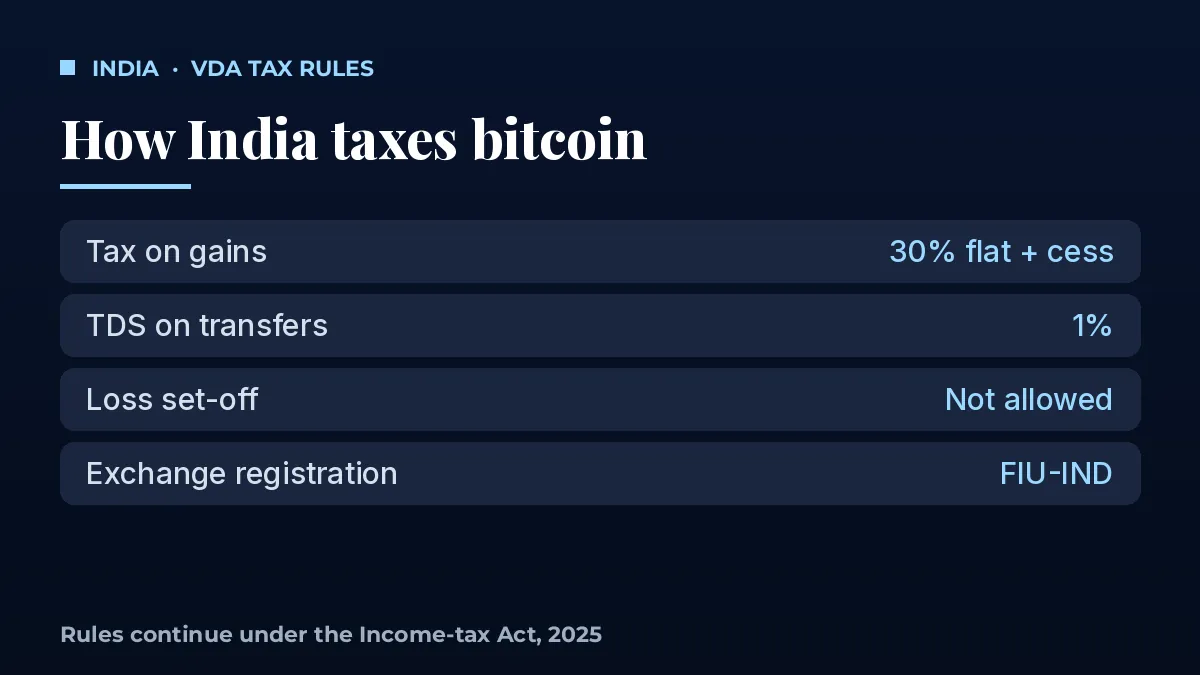
Indian investors should look past the halving narrative to the rules that apply to them. India taxes gains from virtual digital assets (VDAs), including bitcoin, at a flat 30% plus applicable surcharge and cess. A 1% tax deducted at source applies on transfers above specified thresholds. Losses on VDAs cannot be set off against other income, and only the cost of acquisition is deductible.
These rules continued when the Income-tax Act, 2025 replaced the 1961 Act from 1 April 2026. Crypto platforms serving Indian users must also register with the Financial Intelligence Unit (FIU-IND) under anti-money-laundering rules. Before using any exchange, check that it is registered.
Because of the 30% flat tax and no loss set-off, frequent trading around halving events can be expensive after tax. A loss on one trade does not reduce tax on a gain from another VDA.
Five Insights on the Bitcoin Halving
- The schedule is fixed. Every 210,000 blocks, the reward halves. The next cut, to 1.5625 BTC, is expected around 2028.
- Issuance is now tiny. Annual supply growth is below 1% after the 2024 halving.
- Price effects are debated. Past rallies coincided with other factors, such as ETF approvals and liquidity.
- Miners feel it first. Subsidy income halves overnight; efficient miners survive, others exit.
- Indian tax is strict. A 30% flat rate, 1% TDS and no loss set-off change the maths of trading.
What Happens Next
The next Bitcoin halving is roughly 18 months away, depending on block times. Expect the narrative to return as the date approaches. Treat it as one known supply input, not a trading signal. Size any crypto exposure so that a large fall would not hurt your core goals.
For a wider view of risk, read our guides on managing market volatility without emotion, the four core financial risks, how to spot misleading investment claims, and inflation and wealth preservation.
Frequently Asked Questions
When is the next Bitcoin halving?
The next Bitcoin halving will happen at block 1,050,000. At an average of about ten minutes per block, that points to around 2028. The exact date depends on how fast blocks are mined, so trackers update their estimates as the date approaches. The reward will fall from 3.125 to 1.5625 BTC.
Does the halving always raise the bitcoin price?
No. Earlier halvings were followed by bull markets, but other factors also drove prices, including liquidity and new investor access such as US spot ETFs in 2024. With only a few cycles of data, no reliable rule exists. Prices can also fall sharply after any rally.
How many bitcoin will ever exist?
The protocol caps total supply at 21 million bitcoin. New coins are released through the block subsidy, which halves every 210,000 blocks. Roughly 95% of the cap has already been mined, and the final fractions are expected to be issued around the year 2140.
How is bitcoin taxed in India?
Gains from bitcoin and other virtual digital assets are taxed at a flat 30% plus surcharge and cess. A 1% TDS applies on transfers above specified limits. Losses cannot be set off against other income. These rules carried over into the Income-tax Act, 2025, which took effect on 1 April 2026.
What happens to miners after a halving?
Their block subsidy income halves overnight, while costs stay the same. Less efficient miners may shut down, and others seek cheaper power or new revenue lines. Bitcoin’s difficulty adjustment every 2,016 blocks keeps block times near ten minutes, so the network continues to run.
Sources
- Satoshi Nakamoto, “Bitcoin: A Peer-to-Peer Electronic Cash System”
- US SEC Chair statement on spot bitcoin ETPs (10 January 2024)
- Income Tax Department, Government of India
- Financial Intelligence Unit – India
Disclaimer: This article is for education only and is not investment, tax or legal advice. Crypto assets are highly volatile and largely unregulated; you can lose your entire investment.